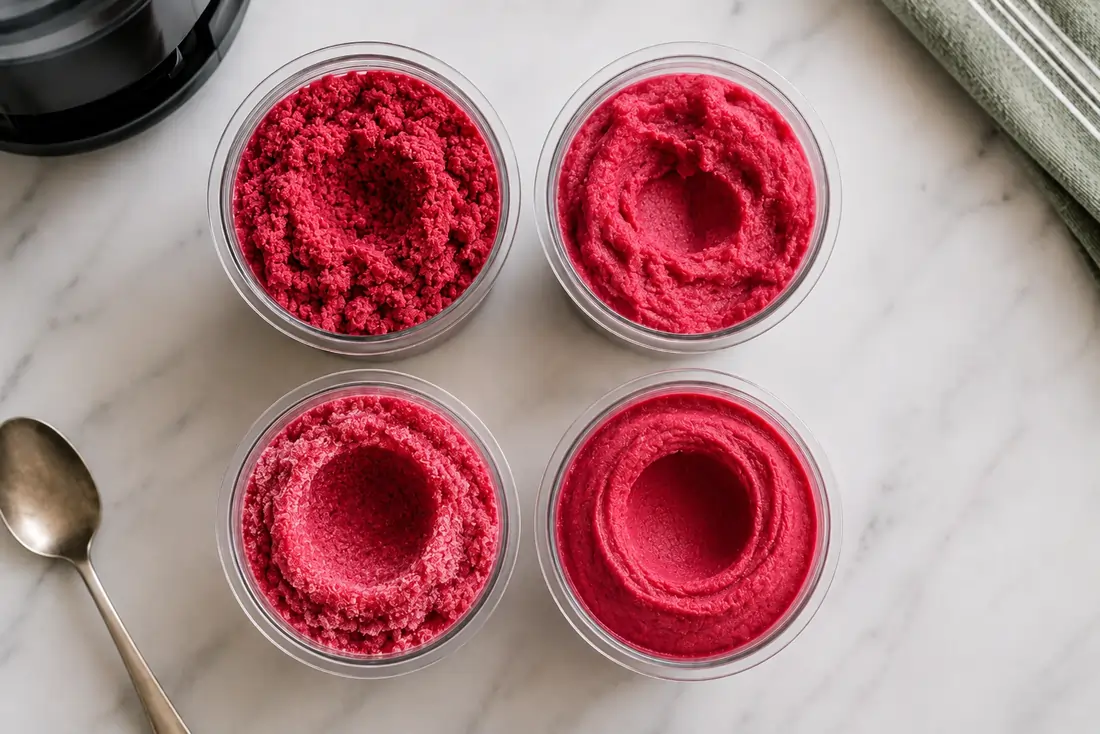
Re-spin is a normal finishing step when a first cycle leaves a Ninja CREAMi base crumbly or powdery. Inspect the result before using it. Add liquid gradually only when the texture remains dry and compacted particles will not come together.
Before continuing: do not use Re-spin before Mix-In. For refrozen leftovers, follow the owner guide for your machine. Several Ninja guides recommend repeating the original program when evenly refrozen leftovers become hard, while other guidance differs.
Inspect the result before doing anything
Lower and remove the outer bowl, then look at the whole pint.
- Fine, loose crumbs or powder: Re-spin is appropriate.
- Mostly smooth with a small dry patch: level the surface lightly and Re-spin; liquid may not be necessary.
- Hard, icy or grainy: Re-spin may soften it, but the base balance may be the real issue. Use the texture diagnostic.
- Soft, glossy or slushy: do not add liquid or Re-spin automatically. The pint may be too warm, underfrozen or too high in sugar or fat.
- Pieces still need adding: skip Re-spin and use Mix-In as the recipe directs.
- The machine stopped, shows an error or made an abnormal noise: stop and consult the owner guide or support rather than repeating cycles.
When to use Re-spin
Use Re-spin after a completed main program when the result is crumbly, powdery or not yet cohesive. Official Original, Deluxe and Swirl FAQs describe this as its central purpose, especially for very cold bases.
Re-spin can also soften a freshly processed Swirl Soft Serve base that is too firm to dispense, after confirming that the pint base is open and the nozzle is clear. Swirl support notes that one or two Re-spins may sometimes be needed for a very cold base; this is a model-specific dispensing case, not a general target for every pint.
When not to use Re-spin
Do not Re-spin when:
- the result is already smooth enough;
- it is soft or melting;
- Mix-In will be the next program;
- leftovers have been refrozen and your machine’s owner guide gives a different reprocessing step;
- the surface froze at an angle or was refrozen unevenly;
- the base contains a hard ice block, loose frozen ingredients or other material the manual prohibits;
- assembly, motor load or an error code needs attention.
Repeated processing adds friction and warmth. A pint that becomes glossy, loose, gummy around the paddle path or progressively warmer is no longer being improved by more cycles.
When and how to add liquid
First run Re-spin without liquid when the first result is simply powdery. If it remains dry after inspection, make a narrow well in the centre and add a liquid that belongs in the recipe.
Practical starting point, not a manufacturer specification: begin with 1 teaspoon / 5 ml for a 16 oz/475 ml pint. For a very dry full pint, increase gradually up to about 1 tablespoon / 15 ml before the next Re-spin. A Deluxe 24 oz/709 ml pint may need proportionally more, but add it in small steps rather than pouring freely.
The aim is to help the particles bind, not to flood the pint. If the dessert becomes pourable, the adjustment was too large or the original base was not suitable for the desired scoopable texture.
Choose the liquid by recipe type
| Recipe | Suitable small addition | Likely effect |
|---|---|---|
| Classic dairy ice cream | Milk, cream or reserved base liquid | Milk loosens more; cream preserves richness but can soften the result. |
| High-protein or lite | Milk, unsweetened plant drink or reserved protein base | Too much liquid quickly turns a scoop into a soft pudding-like texture. |
| Sorbet | Fruit juice, purée or a little water that matches the recipe | Water dilutes flavour and can refreeze icier; juice or purée preserves more flavour. |
| Frozen yogurt | Milk, drinkable yogurt or a spoonful of the original yogurt mixture | Thicker yogurt changes texture less abruptly than free-flowing milk. |
| Dairy-free ice cream | The same plant drink or coconut mixture used in the base | Avoid introducing a conflicting flavour or allergen. |
| Swirl soft serve | Follow the Swirl recipe first; use Re-spin before improvising liquid | Dispensability depends on the complete formulation, not moisture alone. |
How many times to Re-spin
There is no universal number. One Re-spin is a reasonable first response to a dry first cycle. Inspect again before doing more.
For most scoopable recipes, continuing beyond a second finishing pass should prompt a diagnosis: the freezer may be unusually cold, the pint may be underfilled, or the base may be too low in sugar, fat or solids. Swirl support specifically allows that one or two Re-spins may be needed to soften a very cold fresh base for dispensing, but advises serving it from the pint if dispensing errors continue.
Stop when the dessert is smooth enough to serve, even if it does not match a photograph exactly.
Common mistakes
Adding a large splash before the first spin
This changes the recipe before the machine has shown whether an adjustment is needed. It often produces an overly soft centre and a firmer outer wall.
Re-spinning before Mix-In
Official guidance says to proceed directly to Mix-In after the main cycle. The Mix-In pass also works the base while folding in pieces.
Treating Re-spin as a recipe repair button
It cannot make a partially frozen pint safe, balance a water-heavy sorbet, correct overfilling or turn loose frozen fruit into an approved base.
Reprocessing leftovers
Flatten leftovers before refreezing, then follow the owner guide for your machine. Several Ninja guides recommend repeating the original program when the level surface becomes hard. Mix-ins may be crushed more finely on reprocessing.
Ignoring temperature and fill level
Official Deluxe support notes that a pint filled below halfway can produce more crumbly output because the processed mixture has extra space to climb the walls. Very cold freezers can also increase the need for Re-spin.
Re-spin by recipe category
- High-protein: powdery first results are common in lower-fat formulations. Re-spin dry first; add only a measured amount of the base liquid. See high-protein recipes.
- Low-calorie: low fat and lower sugar reduce softness. Follow a tested recipe and avoid compensating with repeated large pours. Browse under-100-calorie recipes.
- Sorbet: a dry first spin can benefit from Re-spin, but persistent iciness usually points to fruit, water and sugar balance. See sorbet recipes.
- Dairy-free: match the added liquid to the base and its allergens. Explore dairy-free recipes.
- Beginner-friendly: these recipes are a general place to learn the normal first-spin appearance, not a category that inherently needs more Re-spins. Start with the beginner-friendly collection.
Frequently asked questions
Should milk always be added before Re-spin?
No. Re-spin the dry first result without liquid. Add a measured amount only if it remains too dry to bind.
Can Re-spin be used twice?
It can be reasonable after inspecting between cycles, particularly for a very cold pint. Stop if the dessert is warming, loosening or no longer improving.
Why did Re-spin make the dessert too soft?
The pint may have warmed, contained too much sugar or fat, or received too much liquid. Return a uniformly level pint to the freezer if needed; do not keep processing a melting result.
Can Re-spin fix an icy sorbet?
It may improve the immediate serving texture, but persistent iciness usually comes from the recipe’s water, sugar and solids balance. Use the full texture guide.
What about refrozen Swirl leftovers?
Close the pint base, remove and rinse the nozzle chamber, reinstall the nozzle, flatten the surface and refreeze. When the leftovers become hard, use the reprocessing step given in the Swirl owner guide.